
By Emelia Schwulst
Notice your plants are looking a little lackluster, stunted, and yellow? It may be time to fertilize! But with the wide variety of options, which product is best for you and your plants? How do these fertilizers work, and how should you use them? With these questions, you are in the right place. In this guide, you will find the right fertilizing product for you here at Colonial Gardens and learn some of the science behind how these products work to beautify and supplement your plants!
The Science Behind Fertilizers
Simply planting a plant in the ground does not guarantee new growth. The fact is that plants cannot do all the work themselves when it comes to nutrient uptake in soil. The root system of a plant is useless without microbiota, like bacteria and fungi, aiding the process. Bacteria produce organic acids and enzymes that break down stone and rock into organic matter in the ground, allowing bacteria to consume the minerals and macronutrients within it. To make the consumed nutrients bioavailable, chelation occurs. Chelation in plants is when metal nutrients, or minerals, bind to amino acids and can then be absorbed by the root system. This occurs when bacteria consuming nutrients die, and fungi distribute the released nutrients through a symbiotic relationship with plant roots called mycorrhizae, in which microscopic threads called hyphae absorb them. This process occurs rapidly to outcompete other biotic competitors for these precious nutrients. As a reward, plants provide fungi with sugars (carbohydrates) produced by photosynthesis.
But how is this relevant to fertilization? Well, poor plant performance is most commonly the result of insufficient nutrients in the soil surrounding the roots. This is where fertilizer comes in to save the day! Fertilizer works by introducing an abundance of nutrients to the soil that boost the microbial community and, in turn, boost plant nutrient levels.
Slow-Release vs Fast-Release
There are a few different ways nutrients are released into the ground: slow-release and fast-release. Depending on the plant type and fertilization goal, it is important to know when to use which product.
Slow-release fertilizers can be organic or non-organic. The fertilizer’s coating or material determines how slowly the product dissolves. Non-organic typically has a synthetic material coating the nutrients that dissolve and leach into the ground, typically a synthetic polymer or molten sulfur. Organic fertilizers are composed of composted materials or bone meal. Slow-release is best used in perennials. The organic option is better for soil health and works better with the microbiota.
Fast-release fertilizers are primarily synthetic and generally consist of urea, ammonium sulfate, ammonium nitrate, and potassium chloride. These nutrients are water-soluble and absorb quickly within the plant. These are best used on annuals to keep them lush and blooming during the season.
How to Interpret the Label And What We Carry
All fertilizers have three consecutive numbers on the packaging. This is known as the NPK, and helps the consumer identify the ratio of macronutrients essential for plant growth. NPK represents the concentrations of nitrogen, phosphorus, and potassium in the product. Depending on the desired outcome, these ratios can significantly improve the plant’s overall lushness, health, root strength, and fruiting.
All or isolated- these nutrients can be customized to match the gardener’s preference. Nitrogen aids the plant by increasing chlorophyll production, making the overall appearance lusher and greener, and helping to buffer foliage at the expense of flowers and fruit. Want fruit and/or flowers? Then make sure to choose a fertilizer high in phosphorus, which is critical for energy production in plants during reproductive phases and promotes bud formation. If a healthy, more disease-resistant plant is what you are after, then a fertilizer with a higher concentration of potassium is recommended, as potassium helps to boost plant immunity.
It is important to note that nitrogen, phosphorus, and potassium (NPK) are not the only macronutrients beneficial to plants. Other nutrients such as calcium, magnesium, and sulfur act as secondary macronutrients. Calcium strengthens the plant’s cell walls and reinforces its structural integrity. Magnesium acts similarly to nitrogen, promoting lush, green foliage and maximizing the uptake of other nutrients by the plant. Sulfur is vital for protein formation in plants and accelerates plant growth.
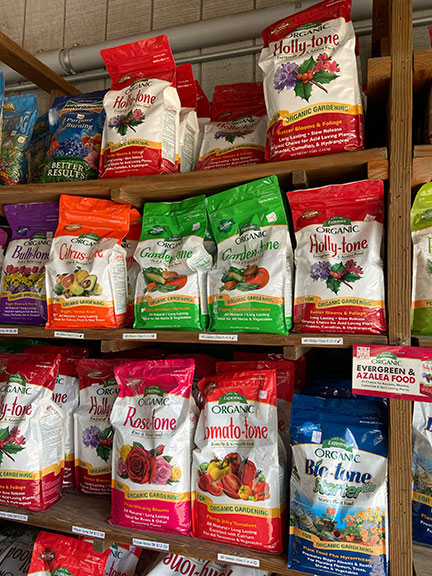
With six distinct macronutrients for plants and several more micronutrients, there are countless combinations of nutrient ratios; thus, the vast market for fertilizers. At Colonial Gardens, we carry a wide range of products, including the Espoma and Bud and Bloom brands, which we will highlight in this guide.
Espoma
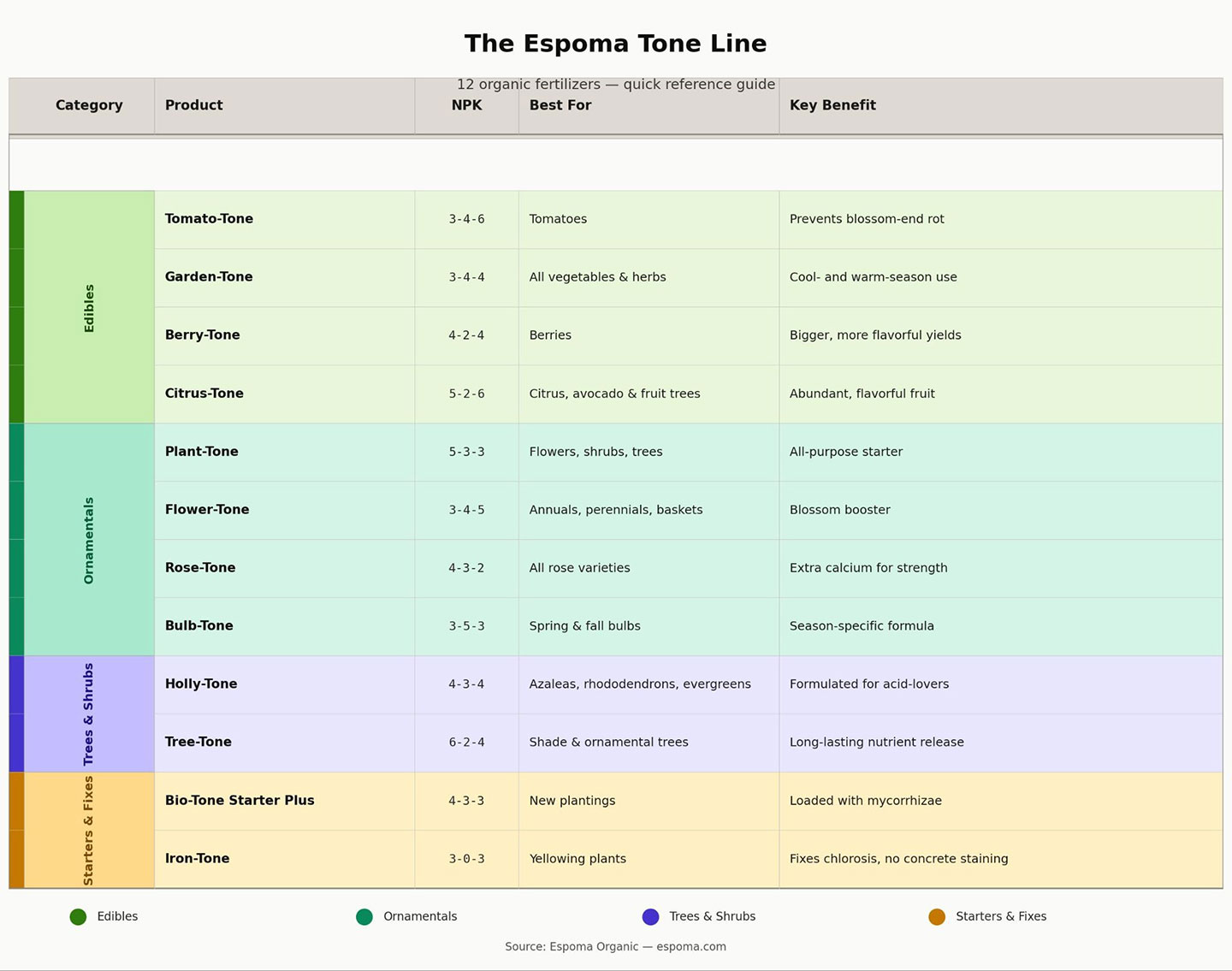
Here at Colonial Gardens, we carry a wide variety of Espoma fertilizing products. Espoma, founded in 1929, is the nation’s number-one distributor of organic fertilizer products. The company is relatively local with a manufacturing facility in Hegins, Pennsylvania. Their products are consumer-friendly and offer over 50 distinct fertilizers. At Colonial, we primarily carry the ‘Tone’ line of Espoma products, which feature approximately 12 different plant-specific products. Bio-Tone is an excellent starter fertilizer with an NPK of 4-3-3, 9,000,000 Colony Forming Units per gram of 6 bacterial species, and 55,555 propagules per gram of 5 ectomycorrhizal fungal species. This product is packed with essential plant-food nutrients and the microbiota needed for nutrient uptake.
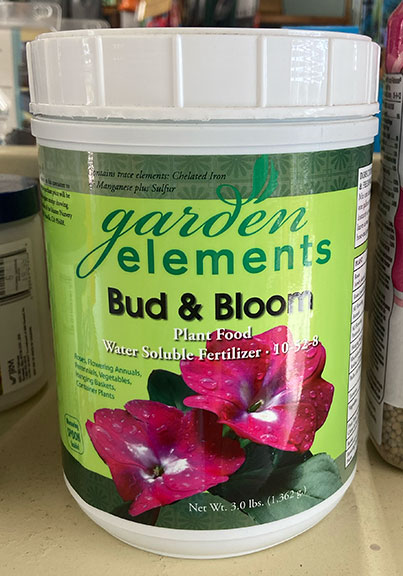
Bud-and-Bloom
This is a great product that we recommend for our annual plants and hanging baskets. This fertilizer is fast-acting, delivers a large amount of phosphorus to the soil, and is absorbed by the plant through its roots and leaves. The NPK on these products is typically represented by numbers such as 10-52-8. Bud-and-Bloom works to push the plant to perform at its best, which will eventually strain it, so we primarily recommend this product for annuals only. This fast-release fertilizer will keep annuals looking lush, vibrant, and healthy during their short season.
General Tips and Info:
- The optimal temperature window for fertilizing your plants is 50-85 degrees Fahrenheit; temperatures above this range can cause fertilizer burn, and temperatures below it can result in inactive microbes that prevent nutrient uptake, leading to nutrient waste and runoff.
- Wear gloves during application to prevent chemical burns or allergic reactions.
- The best time to fertilize perennials is early spring, after their dormant period, and a mid-summer boost to keep them lush throughout the season.
Conclusion
Shopping for a fertilizer can definitely be a little daunting given the range of products on the market today. Hopefully, with the help of this guide and the science behind the label, you will now be able to make an informed decision for your fertilizing needs. Beautiful, lush plants await you! Be sure to swing by Colonial Gardens and ask any questions you may have and shop our selection of fertilizing products!
Emelia Schwulst is a member of our Plant Care Team entering her third year at Trinity College. She is studying biological and biomedical sciences and is excited to apply her degree to her work at Colonial Gardens.