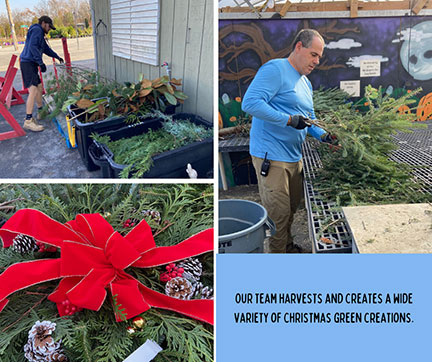
Here at Colonial Gardens, an independent garden center located in Phoenixville, Pennsylvania, we use a variety of greens to hand make our custom pieces, including some that we grow on our grounds. We’re not gate-keeping this secret to harvesting your own greens to make chic looking planters for (basically) free. In this blog, we’re partnering our gardening expertise with our extensive experience in Christmas decoration production to give you the secrets to making your own Christmas decorations.
What can I make?
- Wreaths, Swags, and Boughs for use on doors, windows, and mailboxes
- Garlands for wrapping around porch railings and fences
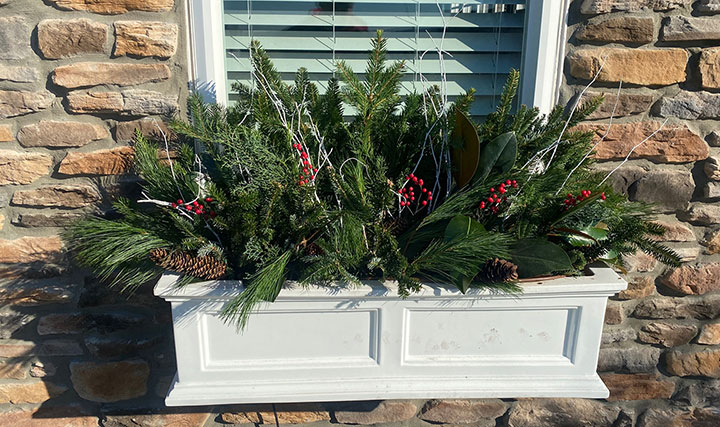
- Porch pots for a decorative welcome to your home
- Grave boxes and blankets to honor someone who has passed
What items can I grow?
- Various evergreens for the base of these decorations
- Berries for pops of colors
- Decorative twigs and branches for structure and height
What else might I need that I can’t grow?
- Pick up a pair of pruners and paddle wire from your local, independent garden center like Colonial Gardens
- Extra large cones from species of pine that are not hardy in our area
- Ribbon or pre-made bows (we can make custom ones at Colonial if you’re not feeling crafty)
- Other artificial elements as desired like ornament balls, cardinals, snowflakes, etc.
What to Grow
Greens:
Evergreens are the basis of any good porch pot, wreath, or garland. They are also abundantly available in our area. The key to adding depth and texture to your porch pots and other decorations is to incorporate a variety of greens to capitalize on different textures and colors.
In the garden, evergreens are the foundation of your plantings. They provide four-season interest and anchor the rest of the plantings with structure. You have a lot of options at your disposal here, but we’re going to outline our favorite evergreens that double as winter planter materials. These can also double as live outdoor Christmas trees after you’re done with your harvest.
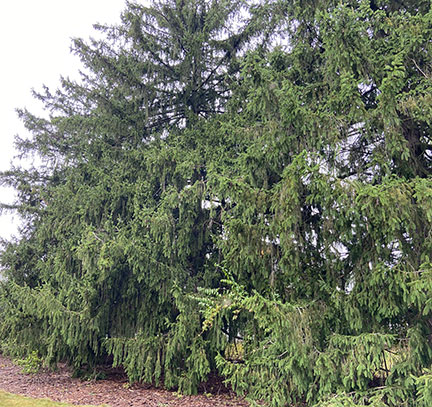
Spruces: Spruces have short, square-shaped needles that have that classic “Christmas tree” feel when cut. This dense blanket of needles all along the branch gives you a strong base for your wreaths and other hanging decorations.
How to Grow: First, select a spot that can accommodate your selected spruce tree. Dwarf alberta spruces stay a manageable 8 to 12’ tall and can even be planted in containers temporarily. Norway spruces, on the other hand, can grow up to 80 feet tall and should be reserved for spaces away from the house like a property boundary. Most spruces prefer full to part sun conditions with soil that dries out between rainfall. Be mindful to give the spruce plenty of space to achieve its full size; you don’t want to constantly brush up against those needles along a pathway.
Pine: While spruces, pines, and firs all produce green foliage in the form of needles, pines tend to have much more narrow and longer needles giving them a completely different texture. That is less structural and more fine. White pines are often used in garlands as the narrow parts of their branches are quite flexible, and the foliage makes an impact. Incorporate white pine in your planters and wreaths to add a soft variation in foliage texture. Pine used in planters will drape down along the rim of the pot. Different species of pine trees produce pinecones of various sizes and textures that are a lovely addition to just about any planter.
How to Grow: there are a wide variety of pines that are available for our growing region. Most species do best in full sun conditions with soil that is allowed to dry out. Some pines will reach large sizes of 40 feet, eventually forming a dense matter of needles beneath their shade, which can make it difficult to grow plants underneath them. They are excellent for the border of your property and some smaller varieties do well as stand out specimens within the bed.
Holly: Using holly around the holidays has its roots deep in European pagan cultures where the winter solstice is important. Holly has a unique shape, texture, and shine to its leaves that stands out in arrangements.
How to Grow: American hollies are a wonderful tree, but they require lots of space in the long-term. For a smaller option, you can try dwarf Japanese hollies. These evergreen shrubs are commonly used as an alternative to boxwoods and can be grown in full to part sun conditions.
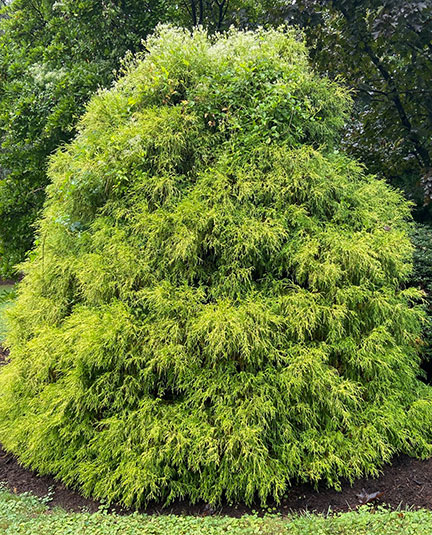
Gold-Thread Cypress: Also known as false Cypress, this hardy shrub (or sometimes tree) is known for its soft golden evergreen foliage. The texture of this green is perfect for the front of a planter where it can flop over the edge to reveal the centerpiece of cones, berries, or other decorations. The golden color gives nice contrast to the rigid greens of spruces and firs to give wreaths added dimension.
How to Grow: This shrub is best grown in full sun to part shade. Some varieties do best with some shade to preserve consistent gold coloring. The number one mistake that we see with this plant is assuming that it will stay low to the ground as some varieties like gold mop resemble ground covers at first. The truth is that this is at its smallest a 3 to 4 foot shrub and should be given the space to reach full maturity at that height. This means that it should be placed in the middle rather than the front of the garden. Larger varieties can reach up to 20 feet tall as a beautiful conical tree and should be given space to make its full statement in the bed or out in the yard.
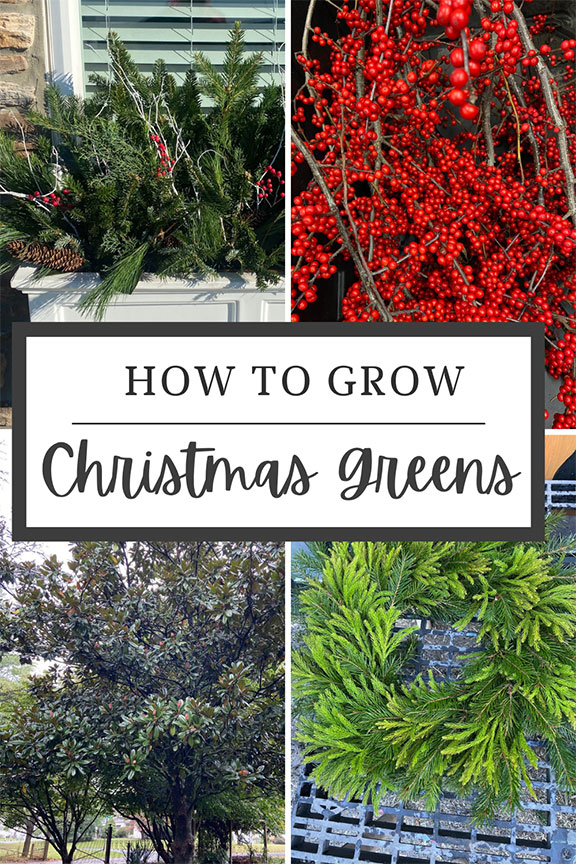
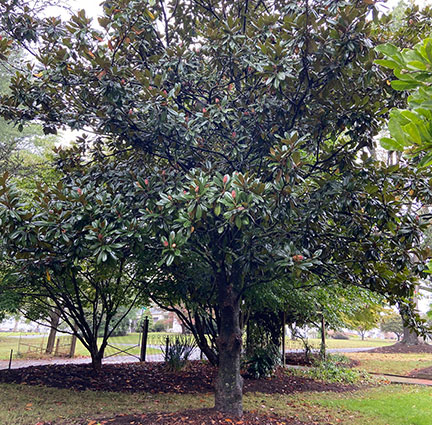
Magnolia: Magnolia leaves elevate any arrangement to look higher quality. Unlike the fine needles of the other evergreens, magnolias have broad, shiny leather, like leaves that have a contrasting texture for greater impact in your planters.
How to grow: While there are many varieties of magnolias that are hardy to our region, choose an evergreen variety like a southern magnolia so that you have access to long branches of these leaves during the Christmas season. In the spring, you’ll be delighted by large bright white flowers with a lovely scent. Some varieties grow to be very large trees so be careful where you choose to grow them so that you can accommodate the tree at its full-size.
Decorative Branches:
Greens are an essential backdrop for fresh decorations but branches and berries give planters structure and pops of color.
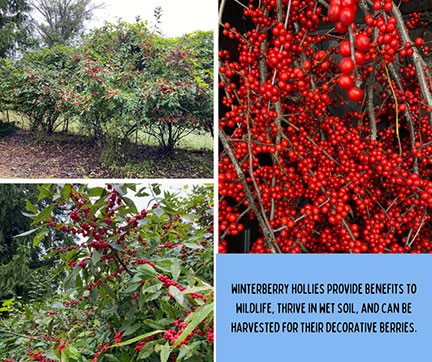
Winterberry Hollies: While greens are certainly the foundation of any Christmas planter, pops of red and white, can give it the holiday flare. Winterberry hollies are a unique deciduous shrub part of the holy family. During the fall, they drop their leaves to reveal long branches laden with clusters of bright, red berries. Cut these branches for a long, lasting natural red element in your planters.
How to Grow: These shrubs are an excellent addition to the border of your garden or any area of your yard that sits particularly wet. These native shrubs provide important food sources for birds during the winter months. They thrive in boggy conditions and produce the best berries when they have access to moisture year-round. A key element to getting berries is to incorporate both a male and female plant in your garden. Only the female plants produce fruits, and they will only do so when pollinated by the male plant. You only need one male to pollinate multiple females, but it must be a compatible variety. We are happy to help you select the perfect pair of winter berries for your yard.
Red-Twig Dogwood: Red twig dogwoods are an excellent way to add structure and height to your planter. Clusters of these branches are used in the center of the pot to rise above the evergreen foliage for stately spray of color. Red twig dogwoods produce naturally red stems, but the stems can also be painted white or covered in glitter to further stand out in your planter.
How to Grow: These native shrubs prefer full to part sun conditions in a wet area. In the spring and summer you can enjoy green leaves that support a large diversity of pollinator larvae. In the fall, the dogwoods will drop their leaves, revealing bright red stems. The red color is most prominent on new stems, so prune your dogwood of old stems to keep the color coming. Classic varieties of the shrub can get quite large on our best suited for the edge of your yard or border. Modern, smaller varieties like Arctic Fire are also available that max out around 4 feet tall.
Honorable Mentions:
Schip Laurel: This broadleaf evergreen is a favorite for privacy barriers as it has great deer resistance and beautiful, shiny leaves. Incorporate these instead of magnolia leaves.
Hellebore: While it’s extremely uncommon for a flower to bloom near Christmas time, some types of hellebore do. If you are designing your garden to maximize its beauty during the holidays, hellebore is your best bet. They are an evergreen groundcover with excellent deer resistance at very least, and at best, you may find some nodding flowers popping up over winter.
Arborvitaes: These classic, fast-growing privacy trees produce soft-textured foliage that is fragrant when cut or crushed. Incorporate these greens from your yearly pruning!
Birch Tree: Yellow birch are shade tree, best known for their stark white bark that pops in the winter. Branches and full trunks from these trees are often used in high-end planters for height, color and contrast.
Colonial Gardens is an independent garden center located in Phoenixville, PA. We’ve been creating our own Christmas decorations for decades, recently focusing on locally growing and harvesting our greens for the freshest product. You can read more about that process here or visit us in late November and December to see it for yourself!